Dental assisting programs aren’t all built the same. Some are thorough, well-structured, and efficient. Others are padded to justify longer enrollment windows or higher tuition. Knowing what a quality program actually looks like — what it covers, what it costs, and what it realistically requires of you — is the starting point for making a smart decision.
Here’s an honest breakdown of what dental assisting programs include, what the good ones do differently, and what to expect from start to finish.
What dental assisting programs actually teach
A complete dental assisting curriculum covers three major areas: clinical skills, foundational knowledge, and administrative competency. The balance and depth of each varies by program.
Clinical skills
This is the hands-on, chairside work you’ll do every day as a dental assistant:
Chairside assisting:
Four-handed dentistry — the coordinated workflow between dentist and assistant — is the core of the role. You learn instrument transfer, suction and retraction, patient preparation, isolation techniques, and how to anticipate the provider’s next move across a range of procedures: restorations, extractions, crowns, root canals, orthodontic adjustments, implant placement.
Dental radiography:
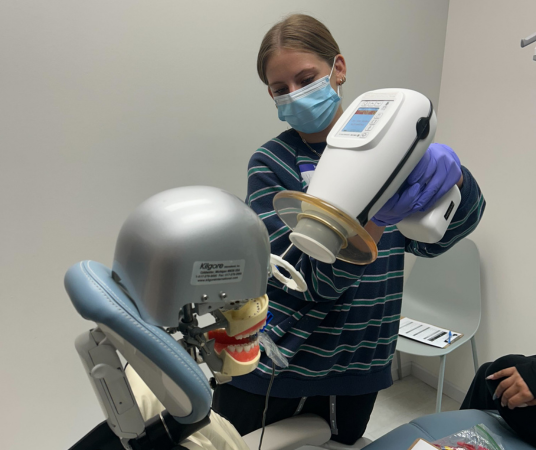
Taking X-rays is a daily task in virtually every dental office. Programs cover digital sensor and film placement, tube head positioning, exposure technique, radiation safety (ALARA principles), and image quality evaluation. X-ray certification is required in most states for dental assistants who take radiographs.
Infection control and sterilization:
OSHA compliance, PPE protocols, instrument sterilization cycles, autoclave operation, disinfection procedures, and biohazard handling. Infection control failures have real consequences, and employers expect new hires to arrive knowing these protocols — not learning them on the job.
Dental materials:
Impression materials (alginate, PVS), composite and amalgam placement assistance, temporary materials, cements, bonding agents, and whitening agents. You learn what each material does, how it’s prepared, and how to assist during its application.
Tray setup and instrument identification:
Building and breaking down procedure-specific instrument trays quickly and correctly is a daily core skill. Speed and accuracy here directly affect how efficiently a practice runs.
Expanded functions (state-dependent):
In states with Registered Dental Assistant (RDA) or Expanded Functions Dental Assistant (EFDA) pathways, credentialed assistants perform coronal polishing, sealant placement, rubber dam placement, and other procedures. Programs that prepare you for these credentials expand your clinical scope and earning potential from day one.
Foundational knowledge
What you need to understand before your hands can do it correctly:
- Dental anatomy — tooth morphology, numbering systems (Universal, Palmer, FDI), surfaces, and periodontium
- Oral embryology and histology basics
- Head and neck anatomy — nerves, muscles, salivary glands, temporomandibular joint
- Dental pharmacology — local anesthetics, analgesics, antibiotics, vasoconstrictors, their mechanisms and side effects
- Patient assessment — medical history review, vital signs, documentation
- Dental specialties — orthodontics, endodontics, periodontics, oral surgery, pediatric dentistry, prosthodontics
Administrative skills
In most practices, dental assistants handle significant administrative responsibilities alongside clinical duties:
- Scheduling and appointment management
- Insurance verification and billing basics
- Treatment plan presentation and financial arrangements
- Electronic health records (EHR) and practice management software
- HIPAA compliance and patient privacy
- Patient communication — pre- and post-operative instructions
What separates strong programs from weak ones
Real clinical training environments
The single most important variable in dental assisting program quality is where the hands-on training happens. Programs that train students in actual working dental offices produce graduates who are clinically ready from day one. Programs that rely on campus simulation labs produce graduates who spend their first weeks on the job closing a competency gap — on their employer’s time.
Ask specifically: Do students train in real dental offices? Not a campus dental lab — a functioning dental practice with real patient flow and real workflows.
RDA/certification prep built into the curriculum
Programs that integrate credential exam preparation throughout — rather than saving it for a last-week review — consistently produce better exam outcomes. The knowledge content should map directly to what your state’s credentialing exam tests.
Transparent total cost
The all-in cost of a dental assisting program should be clearly stated before enrollment: tuition, materials, equipment kit, exam fees. Programs that advertise low program fees and add costs afterward aren’t being straight with you.
Realistic, flexible scheduling
A program that requires full-time campus attendance five days a week is unavailable to most working adults. Look for programs with online or evening knowledge delivery and concentrated in-person lab sessions on weekends.
How long dental assisting programs take
Program lengths vary significantly:
- Short accelerated programs: 10–16 weeks (online-first with concentrated in-person labs)
- Certificate programs: 9–12 months (community college or career school, typically campus-based)
- Associate degree programs: 18–24 months (broader curriculum including general education)
Program length does not directly correlate with clinical quality. A well-designed 12-week program can produce a more job-ready graduate than a poorly structured 12-month one — if the clinical training is real and the instruction is strong.
What dental assisting programs cost
Costs range widely:
- Accelerated programs: $2,950–$6,000 (online-first with in-person lab days)
- Community college certificate programs: $3,000–$10,000
- Career school programs: $8,000–$20,000
- Associate degree programs: $15,000–$30,000+
The most expensive option isn’t the best one. Evaluate cost relative to program quality, clinical training structure, and the credentials it prepares you for.
What completion of a dental assisting program leads to
Job readiness
A quality dental assisting program produces a graduate who can immediately contribute in a clinical dental setting: patient prep, four-handed assisting, radiography, infection control, materials management, and tray setup. Employers can tell within the first week whether someone’s training was real or mostly theoretical.
Credential eligibility
Depending on your state, completing a dental assisting program makes you eligible to sit for:
- Registered Dental Assistant (RDA) exam — state-issued, required for expanded functions
- Certified Dental Assistant (CDA) — national DANB credential
- DANB component exams — Radiation Health and Safety, Infection Control, General Chairside
Certified assistants consistently earn more than uncertified ones. According to Indeed and Glassdoor (2026), the credential premium is approximately $2,000–$5,000/year at entry level — and it grows as you gain experience.
Career growth
Dental assisting is not a dead-end role. Common career paths after completing a dental assisting program include:
- General practice DA → specialty practice (orthodontics, oral surgery, pediatric — higher pay)
- Lead or head dental assistant in larger group practices
- Dental office manager — leveraging clinical and administrative knowledge
- Dental hygiene or dental therapy — for those who want to advance within the clinical field
- Dental sales, product representation, or education — for experienced clinicians
What dental assistants earn in 2026
According to the Bureau of Labor Statistics (BLS) and Indeed (2026):
- Entry-level: approximately $33,000–$40,000/year
- National median: approximately $46,000–$48,000/year
- Specialty practices (oral surgery, orthodontics, pediatric dentistry): $50,000–$62,000+/year
The BLS projects 8% job growth through 2032 — consistent demand in Tyler and nationwide. Dental offices hire trained, certified dental assistants year-round.
How to evaluate any dental assisting program before enrolling
Knowing what a program should cover is only half the equation — you also need to know how to vet what you’re being told. Before committing to any dental assisting program, ask these questions directly:
1. Where does hands-on clinical training happen?
Real dental office or campus simulation lab? This is the most important distinction in program quality and the one most marketing materials are evasive about.
2. What credential does the program prepare you for?
RDA, CDA, or specific DANB component exams? Exam prep should be integrated throughout the curriculum, not tacked onto the final week.
3. What is the total all-in cost?
Tuition plus equipment kit, exam fees, materials, and any additional charges. Get the complete number before comparing programs.
4. Is the schedule realistic for your life?
Does it require full-time weekday attendance, or does it offer online knowledge delivery with weekend lab sessions?
5. What is the average time from graduation to employment?
This is the outcome metric that matters most. A good program should be able to give you a specific, recent answer.
What this program offers
Our 12-week dental assistant program includes:
- Live instruction and self-paced coursework for foundational knowledge
- Hands-on training in real dental offices — not campus simulations
- Credential exam preparation integrated throughout the curriculum
- Radiography and infection control certification prep
Ready to take the next step?